How to read your Flemish EPC (when you don’t read Dutch)
Your notary handed you a document titled Energieprestatiecertificaat. It runs to 30 pages, it is in Dutch, and somewhere in it is the number that determines whether you have a legal obligation to renovate. This guide walks through what you are actually looking at — page by page, in plain English — so you can read your own certificate rather than guessing.
The screenshots below are taken from a real Flemish EPC. Your certificate follows the same layout.
The front page: your score and your label
The bottom half of page 1 carries the three numbers that matter most.
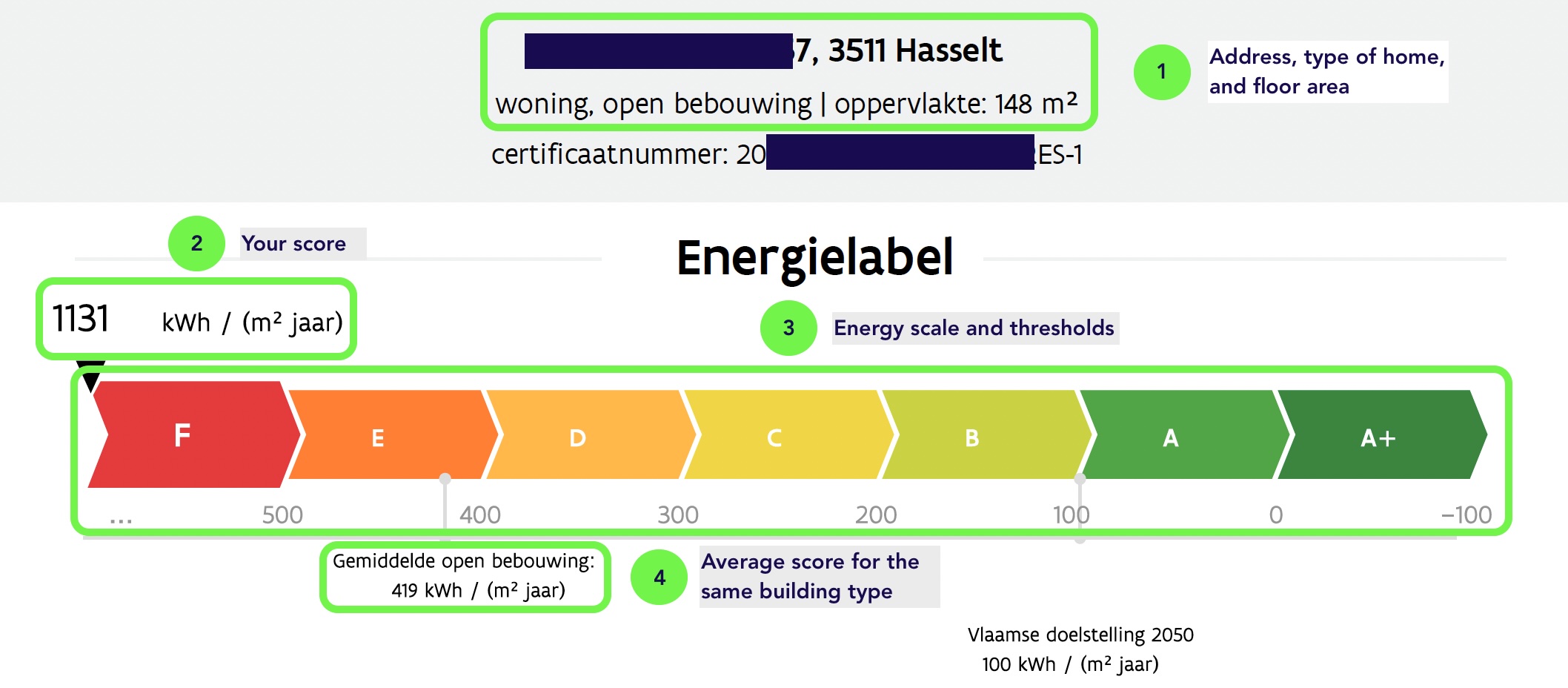
① Address, type, and floor area (oppervlakte) — confirms the property the certificate covers. The type matters: open bebouwing is detached, halfopen is semi-detached, gesloten is terraced, appartement is an apartment. Floor area is the denominator of your score.
② Your score — the headline number, in kWh/(m² jaar). This is your home’s calculated primary energy use per square meter per year. Lower is better. If your score is above 400, you have a renovation obligation.
③ The label bar — A+ (best) to F (worst), with the numeric thresholds printed beneath. The vertical marker shows where your score falls. This is the same grid for houses and apartments.
④ The average for your building type (Gemiddelde) — printed below the bar. A detached house averages 419; an apartment averages 226. This is your “am I normal?” reference.
One thing the score is not: a prediction of your energy bills. The EPC calculates “primary energy,” which accounts for upstream losses — electricity is multiplied by 2.5 to capture power-plant and grid inefficiencies, while gas and oil count at 1:1. If your home scores 500 on 150 m² (1,615 sq ft), that does not mean you will draw 75,000 kWh from the grid. It is a comparison tool, calculated under standardized conditions — including a fixed indoor temperature of 18°C (64°F) — so that every home is measured the same way. Your real bills will differ, and that is by design, the same way an EPA fuel-economy sticker uses a test cycle, not your commute.
The recommendations: what to do with them
Around page 3, the certificate presents its improvement recommendations — one box per building element. Each box has three columns.
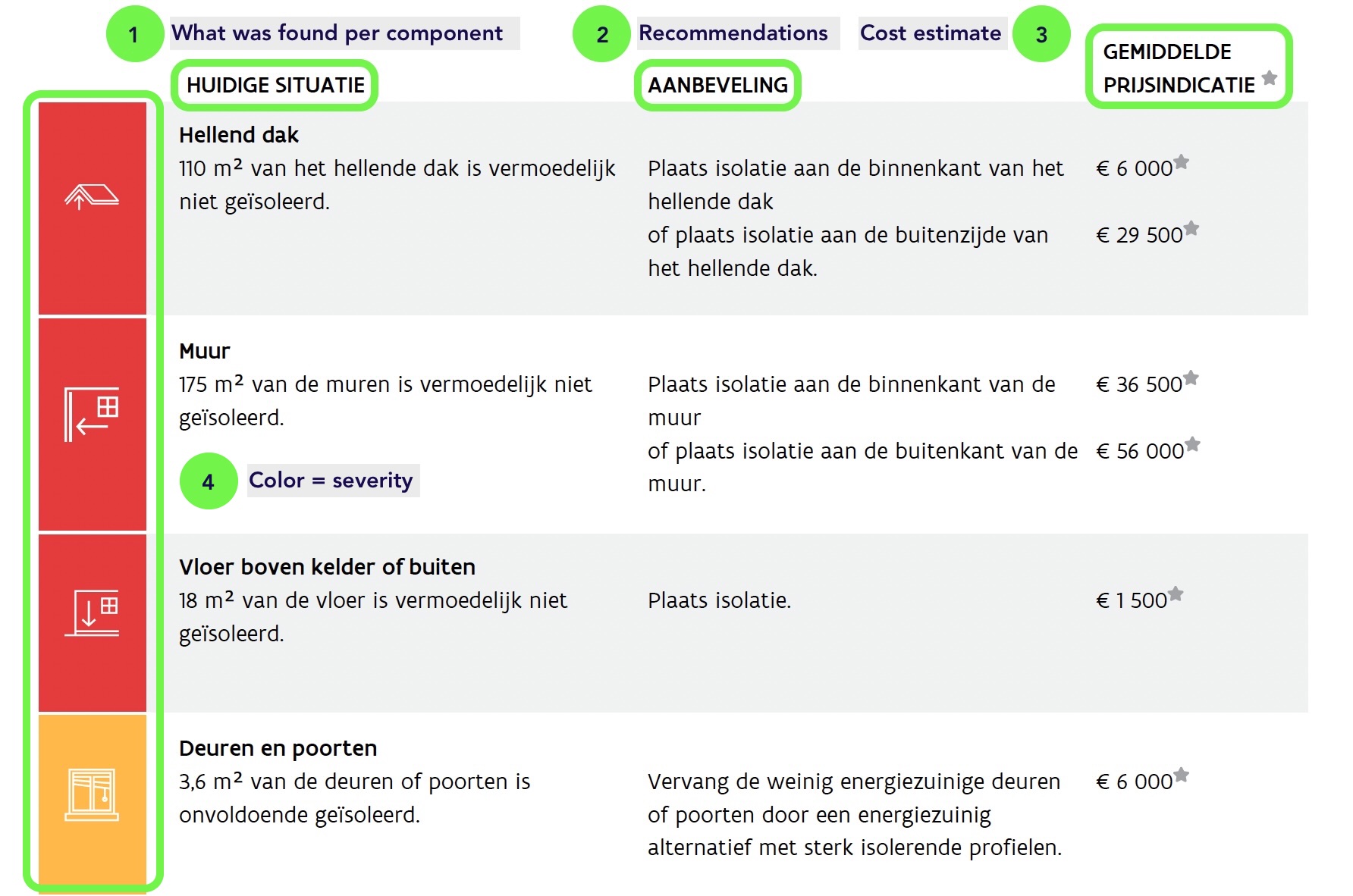
① What was found per component (Huidige situatie) — describes the current condition: how many square meters, whether insulation was found, the measured or calculated performance. This column is in Dutch, but the numbers are universal.
② Recommendations (Aanbeveling) — the EPC’s suggested fix for each element. These are generated by software in a default order — not a prioritized renovation plan.
③ Cost estimate (Gemiddelde prijsindicatie) — an automated benchmark figure. These assume renovation all the way to the 2050 target (label A), not just to your legal target of label D, and they are not contractor quotes.
④ Color = severity. The colored bar on the left indicates performance: red means poor, orange is moderate, yellow is below average. Green items — when they appear — need no work and are worth noting: they tell you what not to spend on.
The key thing to understand: the EPC does not know your budget, your timeline, or which measures interact. A home with a heating system running at 48% efficiency and 110 m² (1,184 sq ft) of uninsulated roof should almost certainly start with one of those two, regardless of where the software puts them in the list.
The technical fiches: the pages most buyers skip
The last third of the certificate contains detailed tables — one per building element — that record exactly what the energy expert found and entered into the software. These technische fiches are the most valuable pages in the document, and almost nobody reads them.
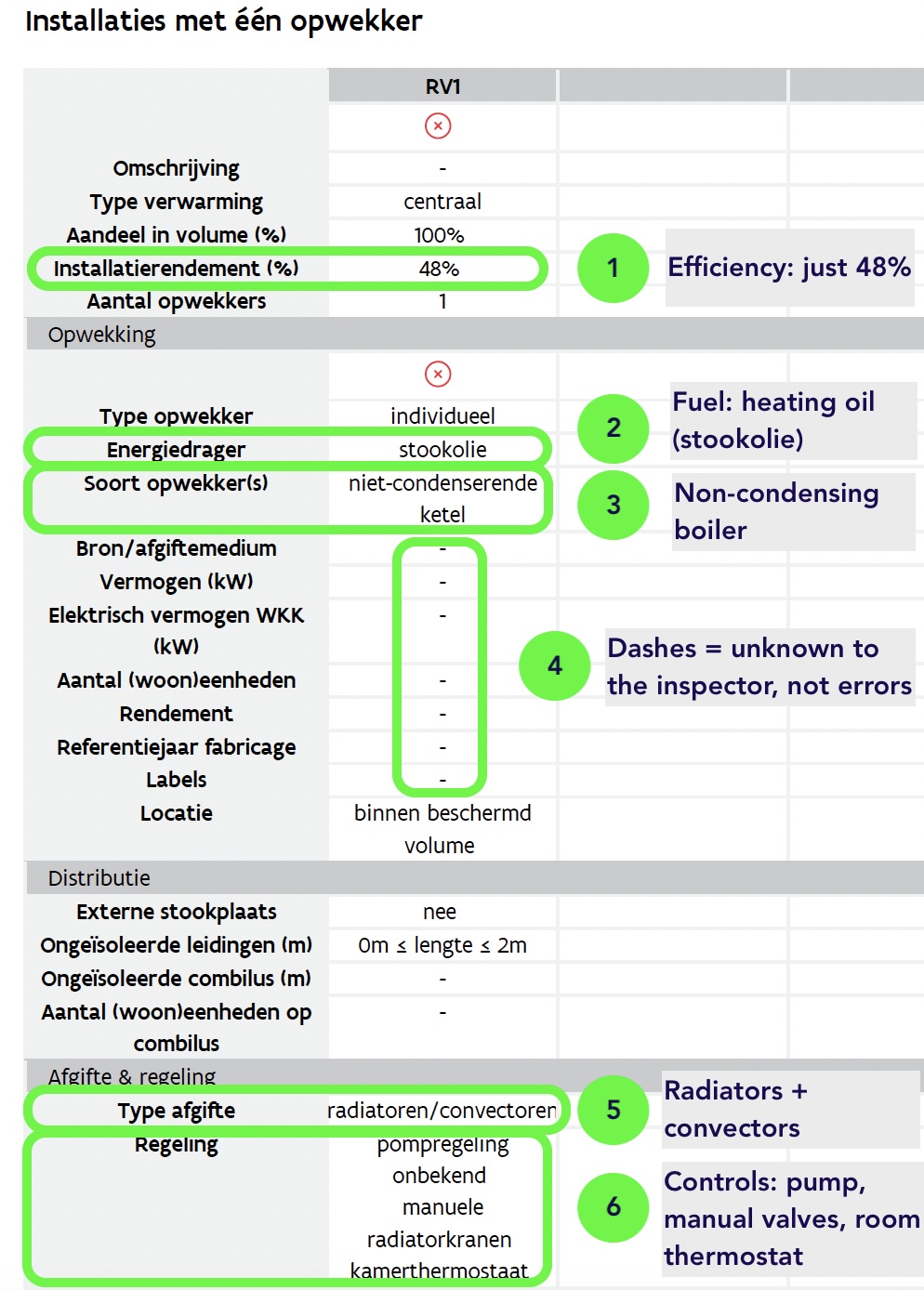
The heating fiche above is a real example. Reading down:
① Installatierendement: 48% — installation efficiency. Less than half the energy in the fuel becomes useful heat. Any boiler below roughly 80% is flagged; 48% means the system is severely outdated.
② Energiedrager: stookolie — fuel type. Stookolie is heating oil; aardgas is natural gas; elektriciteit is electricity.
③ Soort opwekker: niet-condenserende ketel — a non-condensing boiler. Condensing boilers (condenserende ketel) recover heat from exhaust gases; non-condensing ones don’t. The distinction drives a large efficiency gap.
④ The dashes — every “-” in the table means the inspector could not verify or did not record that field. These are not errors; they are gaps. But gaps have consequences. When the EPC software encounters an unknown, it falls back to a conservative assumption — typically the worst-case default for that element’s era. A missing boiler age (referentiejaar fabricage) or unknown power rating (vermogen) means the software assumed the worst. If you can supply documentation (a boiler nameplate, an invoice), a future EPC reassessment may produce a better score without any physical work.
⑤–⑥ Distribution and controls — the emitter type (radiatoren/convectoren = radiators and convectors) and the control setup. Manuele radiatorkranen means manual radiator valves; kamerthermostaat is a room thermostat. The presence of existing radiators is relevant to a heating replacement: it means the distribution is already in place, and a new heat pump or boiler is an appliance swap, not a system build from scratch.
The same fiche structure exists for walls (muren), roof (daken), floors (vloeren), windows (vensters), and hot water (sanitair warm water). In each one, the pattern is the same: look for the U-value — the lower the better, with 0.24 W/(m²K) as the renovation target — and look for isolatie onbekend (insulation unknown). On a 1950s home with unknown wall insulation, “unknown” almost certainly means “none” — but the EPC cannot say so without evidence, so it records what it can prove. A contractor’s cavity check or an endoscope inspection resolves the question for a few hundred euros and may change the renovation strategy entirely.
Red flags worth a closer look
Three patterns in the fiches deserve extra attention:
Very low heating efficiency — anything below 60% is a system running on borrowed time, and the lower it is, the larger the score improvement from replacing it alone.
“Geen of onvolledig” ventilation (none or incomplete) — today the home ventilates through leaks. Once you insulate the roof and walls, those leaks close, and without a deliberate ventilation system the result is moisture, condensation, and poor indoor air. Plan ventilation into the insulation work, not after it.
Unknown build year (onbekend bouwjaar) — not a defect in the certificate, but it shifts every material assumption to worst-case defaults. If the build year can be established from municipal records or the planning information report (vastgoedinlichtingen), it may improve the baseline score and change which measures the EPC recommends.
Your next step
Your EPC is a 30-page document in a language you may not read, but the information in it is yours — and it is the foundation of every renovation decision you will make over the next six years. If the certificate is sitting in a drawer because it is in Dutch, that is the problem we exist for. Our Owner’s EPC Review translates your certificate into a plain-English report — your score, your legal position, and your smartest first steps — delivered within 48 hours.
Your EPC, in plain English
Our Owner's EPC Review translates your certificate into a decision report — your score, your legal position, and your smartest first steps. Delivered within 48 hours.
Order your Owner's EPC Review →Screenshots are from a real Flemish EPC, anonymized. Your certificate follows the same layout. Rules as described are current as of June 2026; for later changes, consult vlaanderen.be and energiesparen.be.